
CASINO
Atlantic City Casino Jobs Sit in the Path of Expansion
Atlantic City casino-hotel jobs already sit at a nine-year low, and an Atlantic County study puts 5,105 of them in exposure by 2035 even without North Jersey.

Atlantic City’s nine casino hotels employed 21,172 people in April 2026, fewer than at the pandemic low, even as New Jersey’s gaming taxes hit records. The Division of Gaming Enforcement put statewide gaming win at $579.6 million in September, up 2.8 percent, because internet play covered a drop on the floor and at the sportsbook.
On October 20, the Greater Atlantic City Chamber and the Atlantic County Economic Alliance walked South Jersey lawmakers through what that split means for the people who still punch in on the Boardwalk, and for the towns that house them, if New York’s new tables mature and North Jersey ever gets a vote.
Internet Gaming Already Pays More Than the Casino Floor
The DGE’s September 2026 total gaming revenue results show internet gaming win at $274.8 million, up 13.0 percent from $243.1 million a year earlier. The nine casino hotels won $227.8 million, down 1.3 percent from $230.7 million. Sports wagering gross revenue was $77.0 million, down 14.3 percent from $89.8 million.
Online play beat the physical floors by $47.0 million in the month. Through September, internet win was $2.40 billion, up 13.2 percent from $2.12 billion, and it ran $0.16 billion ahead of the $2.24 billion casino-hotel win, which was up 1.4 percent. Sports wagering is the weak leg: $748.4 million year to date, down 6.3 percent from $798.5 million. Combined win for casinos, racetracks, and their partners was $5.39 billion, up 5.1 percent from $5.13 billion. Gross revenue taxes were $82.7 million in September and $756.8 million through nine months.
THE SEPTEMBER SPLIT
| Channel | September 2026 | Vs September 2025 | Year to Date | Vs 2025 YTD |
|---|---|---|---|---|
| Casino hotels | $227.8 million | -1.3% | $2.24 billion | +1.4% |
| Internet gaming | $274.8 million | +13.0% | $2.40 billion | +13.2% |
| Sports wagering | $77.0 million | -14.3% | $748.4 million | -6.3% |
| Total | $579.6 million | +2.8% | $5.39 billion | +5.1% |
Slot win rose 4.6 percent to $177.9 million, which Casino Control Commission Chairman James Plousis read as a sign that visits held up. Table-game win fell 17.6 percent to $49.9 million, and he blamed better luck for players for the gap between those two lines. Borgata Hotel Casino & Spa still led the market at $55.6 million, down 11.3 percent. Hard Rock Hotel & Casino Atlantic City took in $43.4 million, down 4.3 percent. Ocean Casino Resort was the large property in the green, at $42.6 million, up 7.6 percent.
Plousis said internet gaming hit $2.40 billion in nine months faster than in any prior year, and he expects it to keep beating in-person win through the shoulder season. Max Slusher, ACEA’s director of business development and the author of the county study, told the October 20 briefing that, after inflation, brick-and-mortar gross gaming revenue is slipping while online expands at about double-digit rates, and that sportsbook numbers are already showing the bite of future markets.
The tax office is not hurting. The Lloyd D. Levenson Institute of Gaming, Hospitality & Tourism at Stockton University, working with the Casino Association of New Jersey, counted $1.1 billion in taxes and fees from Atlantic City casinos in 2025, up 24.8 percent from $883.2 million. Operators spent $634 million on New Jersey goods and services, $373.9 million of that in Atlantic County, and more than $1.2 billion on property work from 2021 through 2025. ACEA’s study notes that 2025 was the first year online gaming, at $2.91 billion, passed the nine hotels’ $2.89 billion floor win, on a statewide gaming total of $6.98 billion, and that the online gaming tax alone produced $509 million, up 456 percent since 2019.
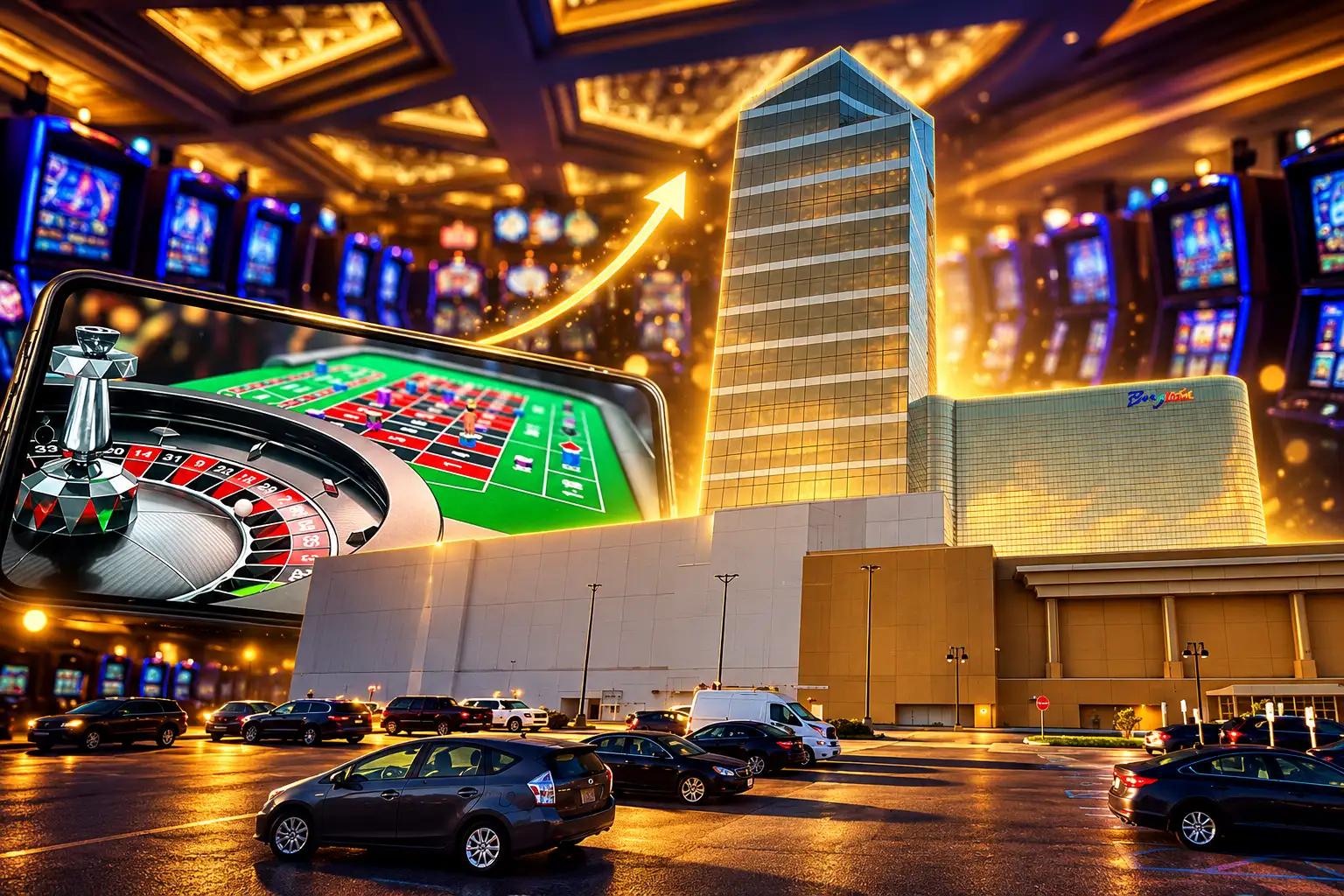
A Nine-Year Low in Casino-Hotel Jobs
That tax engine does not hire like a hotel. Direct casino-hotel employment in the DGE ZIP-code file fell to 21,172 in April 2026, the lowest reading in ACEA’s nine-year panel and 312 jobs below the April 2021 pandemic trough of 21,484. Real brick-and-mortar casino revenue is down 63.7 percent from its 2006 peak of $7.97 billion, in 2025 dollars, to $2.89 billion.
Of those 21,172 jobs, 69.5 percent, or 14,723, sit in five Atlantic County places: Atlantic City (4,638, 21.9 percent), Egg Harbor Township (3,537, 16.7 percent), Galloway Township (2,535, 12.0 percent), Pleasantville (2,420, 11.4 percent), and Hamilton Township (1,593, 7.5 percent). Atlantic City and Pleasantville alone account for 33.3 percent of the statewide casino-hotel workforce. ACEA traces that map to Pinelands growth-area housing and Mount Laurel rules that pushed density into Egg Harbor, Galloway, and Hamilton, which is the stock casino workers still occupy.
A bricks-and-mortar casino needs dealers, housekeepers, cooks, servers, security, and drivers. An app does not. Holding spend constant, ACEA’s input-output run finds that moving $1 million of demand from a casino-hotel to the online channel supports 30.6 percent fewer direct-plus-supplier jobs in Atlantic County, 5.28 against 3.66 full-time-equivalent jobs. Play has already made that trade in people’s pockets, which is why a statewide tax haul can set records while the payroll on the shore shrinks.
Four Planning Cases Through 2035
ACEA’s four planning cases through 2035 are an exposure study, not a closure list. Slusher has been clear that the figures describe jobs placed at risk if several pressures land together, not a date on which a named hotel lays people off. The model starts from the 2025 floor base of $2.89 billion and stacks online substitution, New York City casinos, a recession overlay, and, in the stress row only, two North Jersey casino-hotels.
ACEA PLANNING CASES THROUGH 2035
| Planning case | Floor revenue exposed | Share of 2025 floor | Atlantic County jobs | Regional output |
|---|---|---|---|---|
| Low / blue sky | $237.9 million | 8.2% | 1,490 | $336.1 million |
| Moderate | $741.6 million | 25.7% | 4,647 | $1,047.8 million |
| Central (baseline) | $814.6 million | 28.2% | 5,105 | $1,151.1 million |
| Stress | $1,277.5 million | 44.2% | 8,005 | $1,805.1 million |
The adopted baseline, the central case, assumes no North Jersey casinos at all. It still places 5,105 Atlantic County jobs, $256.2 million of worker earnings, and $1,151.1 million of regional output in exposure, tied to $814.6 million of floor revenue. The same run at the eight-county Southern New Jersey level puts 7,048 jobs in that baseline. Add Meadowlands and Monmouth Park casinos plus a recession and the Atlantic County row jumps to 8,005 jobs, $401.8 million of earnings, and $1,805.1 million of output, equal to 44.2 percent of the 2025 floor. Southern New Jersey’s stress count is 11,053 jobs.
As we have been projecting for the last six months, it would appear that there is, after adjusting for inflation, a falloff in the gross gaming revenue for bricks and mortar, while the online gaming is expanding at about double-digit rates.
Max Slusher, Director of Business Development, Atlantic County Economic Alliance, October 20 briefing
Resorts World New York City at Aqueduct in Queens opened more than 200 live table games on April 28, 2026, the first full casino floor inside the five boroughs. Hard Rock’s Metropolitan Park beside Citi Field, an $8.1 billion project with Mets owner Steve Cohen, is aimed at 2030. Bally’s is targeting 2030 at Ferry Point in the Bronx. The New York State Gaming Commission approved those three downstate licenses on December 15, 2025, each carrying a $500 million licensing fee. Those projects are already in the central case. North Jersey is the extra policy choice.
Bergen and Monmouth Would Collect What Atlantic County Can Least Spare
The proposed new hotels would sit in Bergen County at the Meadowlands and in Monmouth County at Monmouth Park, two of the richer corners of the state. The workers whose shifts would be in play live in one of the poorer ones. Atlantic County Executive Dennis Levinson put that in household terms at the briefing, citing 35,000 people in the county below the poverty line, which he put at $33,000 a year, and a ranking of 20th among 21 counties, with only Salem poorer on his measure.
THREE MEASURES OF COUNTY DISTRESS
- Household income: Atlantic County ranks 19th of 21 New Jersey counties at $76,819, while Bergen sits at $122,232 and Monmouth at $122,727, roughly 60 percent higher, per the ACEA study’s Census-based figures.
- Distress index: On the Department of Community Affairs Municipal Revitalization Index, Atlantic County ranks 3rd most distressed of 21 counties (score 48.5); Bergen ranks 18th (22.9) and Monmouth 17th (23.4).
- Municipal rank: Atlantic City ranks 5th most distressed of 565 New Jersey municipalities and Pleasantville ranks 12th, so two of the twelve hardest-pressed towns sit in one county. Atlantic County’s poverty rate is 11.9 percent, nearly double the host counties’, and its unemployment rate is 5.9 percent, about 50 percent higher.
Slusher told lawmakers the worry is not only casino badges. Restaurants and hospitality suppliers, transportation firms, maintenance and construction contractors, food distributors, and retailers who sell to casino workers all ride the same payroll. A license fee paid to Trenton, an idea some North Jersey backers float as a sweetener, would not put a housekeeper back in Pleasantville. The people on those schedules already live with a smaller headcount than they did in 2021.
Where Displaced Casino Workers Would Go
If thousands of hotel jobs move into exposure, ACEA’s own answer is blunt: not all of them have an obvious next door. The largest local landing spot is the convention and meetings market inside the casino-hotels and next door at the Atlantic City Convention Center and Boardwalk Hall. Banquet servers, cooks, room attendants, and drivers can shift into that work more readily than into an online-ops job in another county.
Visit Atlantic City booked 205 events in 2025 that drew 533,242 attendees, 328,067 room nights, and $362.3 million in direct economic impact, up from $353.7 million in 2024 and $309.0 million in 2023, a 17.2 percent rise over three years. The city has 1,831,333 square feet of meeting space, 901,700 of it inside the nine casino-hotels. Slusher’s policy list starts with funding convention-led hospitality reinvestment so gaming is one draw among several, and with keeping the incentives that led operators to put more than $1.2 billion into rooms, kitchens, and halls over five years.
That hedge is also the target. ACEA cites a 2023 Hunden Strategic Partners study for a Meadowlands convention complex that goes after the same meetings segment and projects more than $3.5 billion in capturable taxes over 30 years from a convention center, a headquarters hotel, and two private hotels. The Meadowlands Chamber in April unveiled renderings of a $3 billion proposed convention center. A North Jersey casino-and-meetings campus would compete for the floor play and for the banquet work Atlantic City is counting on to absorb people leaving the tables.
Voters Already Turned This Down Once
Casino gaming in New Jersey is still a constitutional monopoly. The 1976 amendment confined it to Atlantic City. Building hotels at the Meadowlands or Monmouth Park requires a new amendment, two legislative votes, and a statewide ballot. In November 2016, voters rejected a two-casino North Jersey amendment, 77.5 percent to 22.5 percent, according to the New Jersey Division of Elections figures in the ACEA study.
FROM THE 1976 LOCK TO THE NEXT BALLOT
- 1976: New Jersey amends its constitution to confine casino gaming to Atlantic City.
- November 2016: Voters reject a North Jersey two-casino amendment, 77.5 percent to 22.5 percent.
- December 15, 2025: The New York State Gaming Commission approves downstate licenses for Resorts World New York City, Hard Rock Metropolitan Park, and Bally’s Bronx.
- April 28, 2026: Resorts World New York City opens more than 200 live table games at Aqueduct.
- August 3, 2026: The New Jersey Legislature misses the deadline to put a Meadowlands and Monmouth Park amendment on the 2026 ballot, per an Ark Restaurants Corp. filing with the U.S. Securities and Exchange Commission.
- October 20, 2026: ACEA and the Greater Atlantic City Chamber brief lawmakers in Egg Harbor Township on the jobs study, the same day the state announces new online responsible-gaming rules.
- November 2, 2027: Earliest date a statewide referendum can appear if the Legislature acts; the next general-election window is November 7, 2028.
Ark Restaurants, an investor in New Meadowlands Racetrack LLC, told the SEC that if voters later approve an amendment, the track could open a temporary casino about one year after approval and a permanent building about two years after that, subject to licensing. George Goldhoff, president of Hard Rock Atlantic City and of the Casino Association of New Jersey, was among the operators at the October 20 briefing. ACEA’s written recommendation is to keep in-state casino-hotel expansion off the menu until Casino Revenue Fund protections, worker retraining, and diversification plans are in place for Atlantic City, Pleasantville, Egg Harbor Township, Hamilton Township, and Galloway Township.
New Rules Now Bind the Online Channel
The same October 20 as the jobs briefing, Attorney General Jennifer Davenport and the Division of Gaming Enforcement put mandatory data-driven responsible gaming rules into state regulations, the first such package in the country with the force of law. They apply to internet gaming and online sports wagering operators, which is the channel still growing. Every operator must name a responsible-gaming lead, watch accounts against set triggers, keep an at-risk list, stop promotions at phase 2 and phase 3, hold intervention records for five years, block withdrawal reversals for the first three days, and make cooling-off periods last at least 72 hours.
Reviews are required after deposits of more than $10,000 in 24 hours or $100,000 in 90 days, after $1 million of account turnover in 90 days, after three self-exclusion attempts in 30 days, after a second cooling-off request within 45 days, after three limit increases in seven days, after three withdrawal cancellations in 10 days, after a 50 percent jump in weekly login time, or after two sessions in a week that finish with less than $1 left.
THE THREE PHASES OF INTERVENTION
- Phase 1: Email the customer about deposit, loss, and time limits, cooling-off, self-exclusion, and account closure.
- Phase 2: Require an educational video before any further bets, and cut promotional mail.
- Phase 3: Contact the customer directly; after three failed attempts, suspend the account, and close it if the person still meets at-risk tests after the talk.
Davenport said operators must offer resources, including live support when it fits, to people who are struggling. Interim DGE Director Mary Jo Flaherty said the rules are meant to force early action when the signs show up. Gov. Mikie Sherrill said the state is still writing data-driven practice for internet gaming and online sports wagering and wants the online product tied to help for people who need it. The growing book is now the regulated book. The jobs on the floor are still the ones that fill those five ZIP codes, and they are already fewer than they were in 2021.
The next constitutional vote, if it comes, cannot be earlier than November 2, 2027. Until then the pressure ACEA modeled without North Jersey, online substitution, New York tables, and cost, is the one already on the schedule in Atlantic City, Pleasantville, Egg Harbor Township, Galloway, and Hamilton.

North Fork Mono Casino Opens After California Voted No

Ho-Chunk Gaming Beloit Opens a $705 Million Border Bet

Atlantic City Casino Jobs Sit in the Path of Expansion

The Seminole Tribe’s $4 Billion Hard Rock Guitar Takes the Strip

Star Entertainment’s $1 Million Loss Leaves Sydney Exposed

Atlantic City’s 2025 Tourism Win Left a Thinner Resort

Revo’s Manchester Rebuild Outgrew Its First Approval

The Cosmic Upright Became Light & Wonder’s Quiet Floor Engine

Interior Hands Redding Rancheria the I-5 Casino Frontage

Harrah’s Ak-Chin Hands the Floor to Its Marketing Chief
-
 CASINO1 year ago
Atlantic City’s 2025 Tourism Win Left a Thinner Resort
-
 CASINO2 years ago
Revo’s Manchester Rebuild Outgrew Its First Approval
-
 NEWS2 years ago
The Cosmic Upright Became Light & Wonder’s Quiet Floor Engine
-
 CASINO2 years ago
Interior Hands Redding Rancheria the I-5 Casino Frontage
-
 CASINO2 years ago
Harrah’s Ak-Chin Hands the Floor to Its Marketing Chief
-

 CASINO2 years ago
Bally’s Stayed Listed After the $4.6 Billion Takeover
-

 CASINO2 years ago
New Jersey Asked Miss America Home With No Money
-

 IGAMING2 years ago
Musburger Media Takes VSiN Back After a $5.8 Million Loss