
BETTING
Catskill OTB Closed, Then Lost Its Last Payoff
Catskill OTB stopped bets on November 30, 2024, then a 2025 veto froze up to $2.7 million that counties and racing funds were owed.

Catskill Off-Track Betting stopped taking wagers on November 30, 2024, ending 48 years of horse betting across 13 New York counties. Stand-alone parlors never reopened after 2020, and the last restaurant kiosks were already gone.
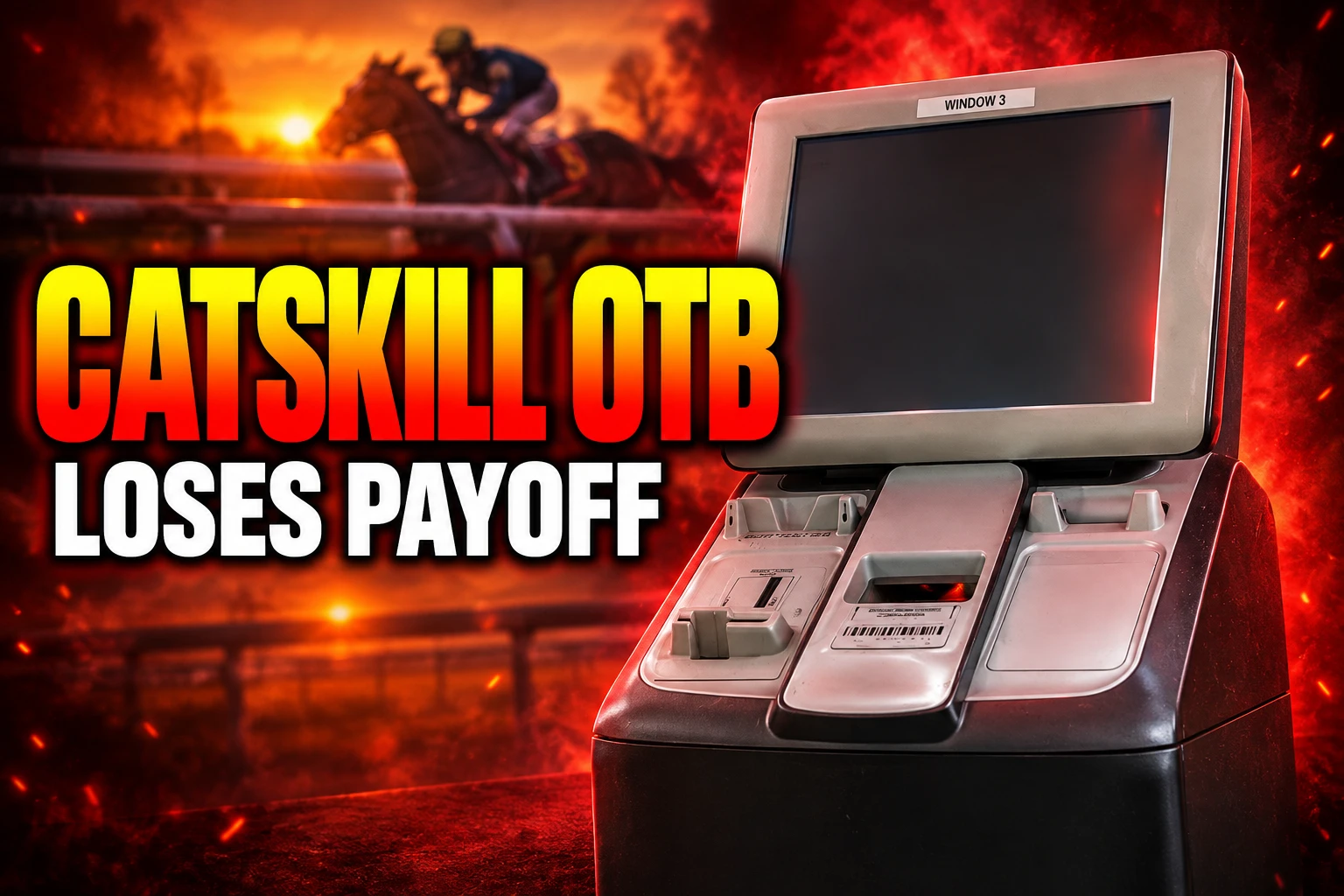
Gov. Kathy Hochul vetoed a 2025 bill that would have let the shuttered operator use up to $2.7 million of its own capital fund to pay counties, racetracks and breeding funds.
Betting Stopped on November 30, 2024
Catskill Regional Off-Track Betting Corporation told customers on its Interbets site that it would stop accepting bets on that Saturday. President and CEO Wanda Williams called it the worst-case end of a long slide, and said horse racing was not growing its fan base. Total betting had fallen, and so had the operator’s take.
The public benefit company opened in 1976 to send a cut of off-track horse bets back to local governments and the racing industry. By the last full year of wagering, that stream was a trickle. Williams had written Gov. Kathy Hochul on November 12, 2024, asking for an emergency meeting and warning the company was in crisis.
THE LAST FULL YEAR
- 2023 handle: Gaming Commission records put horse-race wagers at about $9 million.
- 2023 payouts: About $1 million went to governments and racing combined.
- Lifetime aid: The operator said it had sent $746 million to racing and government since 1976.
- Online book: About 1,000 active customer accounts were still on the books.
Assembly Racing and Wagering Chair Gary Pretlow, a Democrat from Mount Vernon, said he was caught off guard. “I was surprised that they were going to,” Pretlow said. “I do know that there have been fiscal issues with Catskill OTB for a number of years and they’ve been trying to work through it to no avail.”
Hochul Vetoed the Last Payoff for Counties
The betting halt did not clear the ledger. Statutory payments to tracks, breeding funds and counties still sat unpaid, and the money that might have covered them was locked in a capital account that state law reserved for buildings and equipment. Sen. Joseph P. Addabbo Jr. moved a one-year patch, S.8419, to let Catskill up to $2.7 million of its capital fund for those arrears, 45 percent of the fund’s balance, if the Gaming Commission first signed off on a spending plan.
FROM LAST BETS TO A VETO
- November 12, 2024: Williams writes Hochul asking for an emergency meeting and warning the operator is in crisis.
- November 20, 2024: Gaming Commission Executive Director Robert Williams, no relation, answers that Catskill’s own auditor no longer treats it as a going concern.
- November 30, 2024: The company takes its last bets.
- June 12, 2025: The Senate passes S.8419, 58 to 1, with four senators excused.
- June 13, 2025: The Assembly passes the same bill.
- December 5, 2025: Hochul vetoes it as Memo.101.
Williams, writing two days before the veto, said a wind-down starts by settling the books. She warned that a veto would leave nearly $2.7 million frozen in a fund Catskill would never spend on capital work, while municipalities, racing associations and breeding funds lost money that was meant for them. The bill required an expenditure plan, a year-end accounting, and a commission audit paid from the same fund if the plan were abused.
DEBTS THE BILL TRIED TO CLEAR
- Racetracks: Past-due statutory payments to licensed and franchised racing corporations.
- Simulcast bills: Contract costs for the race signals other associations supplied.
- Breeding funds: Arrears to the Thoroughbred Breeding and Development Fund, the state horse breeding fund, and the Harry M. Zweig Memorial Fund for equine research.
- The state and locals: Past-due sums owed New York and the participating county governments.
Those payees did not collect through that bill. The capital account stayed limited to projects that would never be built.
Who Picked Up the Wagers After Shutdown?
The Gaming Commission allowed Catskill to move its online accounts to Suffolk Regional Off-Track Betting Corporation in early December 2024. Suffolk already ran a full advance-deposit book and Jake’s 58, a video lottery casino in Islandia. Catskill’s Hudson Valley bettors did not need a parlor in Pomona if a Long Island public benefit company would take the username and the bankroll.
Phone books had already done most of that work. People who still wanted a New York horse bet could open Suffolk, NYRA Bets, or an out-of-state ADW without driving to a bar kiosk, and the parlor model had no answer for that. Harness-racing regulars treated a Catskill restart as empty talk once the last window closed.
Pretlow put the leak in plain terms. Fans still bet horses, he said, but often not through a New York entity such as NYRA Bets. They use TwinSpires and similar books, and the split of that money is different. Williams had made the same complaint in her shutdown note, saying Albany would rather watch racing bets leave for firms based in other states and countries than keep 100 percent of that handle in New York.
Thirteen Counties and No Video Lottery Terminals
The Catskill region in 13 counties named in state racing law is Broome, Chemung, Chenango, Delaware, Orange, Rockland, Sullivan, Tioga, Dutchess, Tompkins, Westchester, Putnam and Ulster. That map was the whole franchise. Other regional OTBs that still function got a second product Catskill never received: video lottery terminals.
Pretlow said Western New York, Saratoga and Yonkers were written into VLT law because they already had racetracks. Nassau and Suffolk, he said, got terminals through a deal cut by former Senate leader Dean Skelos, not as a rescue of a failing OTB. Bennett Liebman, a former top racing and wagering official in New York, said it is almost impossible for these organizations to keep up with the times when the only product is a horse bet.
WHO GOT MACHINES
- Suffolk OTB: Runs Jake’s 58 Hotel and Casino as a video lottery house, then took Catskill’s leftover accounts.
- Nassau OTB: Places its machines at Resorts World Casino New York City and keeps a Long Island horse book.
- Western OTB: Pairs off-track bets with Batavia Downs Gaming, which is why its overall books held up while its horse handle did not.
Catskill spent years asking for the same kind of device. Bills that would have opened new revenue passed the Legislature and died in Andrew Cuomo’s veto pen, Williams said. Hochul’s 2023 budget, after she had floated shutting the company, instead let it spend capital money on day-to-day costs for a year. That delay bought time. It did not buy terminals.
The Inspector General Found Warehouses of Garbage
Robert Williams did not treat the shutdown as a surprise inflicted by Albany. Commission staff said they learned of the Interbets notice from the press, and that Catskill had not given the formal notice state rules require. He called the charges in the Hochul letter false aspersions and the latest entry in a long management record.
The unfortunate reality is that Catskill is closing its wagering operation because, as your own auditor relates, it is no longer a going concern.
Robert Williams, Executive Director, New York State Gaming Commission, Nov. 20, 2024 letter
A 2018 inspector general report, kept unpublished under Cuomo and released in March 2022 by Inspector General Lucy Lang, described that record in physical terms. From 2008 to 2018 the company spent about $2.2 million to rent warehouses and properties that investigators said were largely used to store worthless items and garbage, including broken televisions, old counters and chairs, and paper records far past any retention rule. Headquarters in Rockland County was so packed with boxes, food, paperwork and trash that the board could not meet there. Investigators found clothes, medicine and personal mail belonging to then-president Donald Groth.
The same report said Groth had retired in 2007, been rehired at once, and collected a state pension alongside his salary. It also cited misuse of a company car and a long relationship with a subordinate. Groth denied wrongdoing. In 2018 the company asked the Gaming Commission for permission to file for bankruptcy. That permission never came. Independent auditors looking at 2022 books wrote that there was uncertainty about the corporation’s ability to continue, with handle down roughly 80 percent from 2009 levels.
Four OTBs Remain as Horse Bets Keep Sliding
New York City’s OTB went bankrupt and closed in 2010. Catskill’s halt left four regional public benefit companies: Capital District, Nassau, Suffolk and Western. Their horse books were already diverging before Catskill went dark. The Gaming Commission’s 2022 statewide off-track betting handle showed Catskill as a thin slice of a system that still moved hundreds of millions of dollars.
2022 OTB HANDLE BY REGION
| Regional OTB | 2022 handle | Machines on the side |
|---|---|---|
| Capital District | $123,136,835 | No VLT casino |
| Nassau | $111,048,623 | Yes, at Resorts World NYC |
| Suffolk | $58,084,730 | Yes, Jake’s 58 |
| Western | $53,557,120 | Yes, Batavia Downs |
| Catskill | $8,583,544 | None |
| All regions | $354,410,852 |
Slots did not freeze the horse decline at the OTBs that have them. State Comptroller Thomas DiNapoli’s April 2026 audit of Western found its horse-racing handle fell 34 percent, or $23.5 million, over the four years through 2024. Western still sent $6.7 million to participating governments in 2024, over $3 million (31 percent) less than the year before, while salaries and professional fees climbed. Video gaming kept the corporation’s overall condition from matching Catskill’s collapse. The horse window, even there, kept shrinking.
Catskill’s leftover capital is still governed by a statute written for expansions that will not happen. The four remaining OTBs still take horse bets. The 13 Catskill counties do not get a local cut of that handle unless a bettor happens to open a Suffolk account, and the frozen fund does not pay the racing bills S.8419 listed.
Frequently Asked Questions
When Did Catskill OTB Stop Accepting Bets?
Interbets stopped taking new wagers on November 30, 2024. The Gaming Commission had told Catskill to file, by November 25, 2024, a written plan for unpaid tickets, vouchers, account balances, racing debts and equipment left in partner bars. Customers were told they could reach funds in Catskill or Interbets accounts through December 15, 2024.
Which New York Off-Track Betting Corporations Are Still Open?
Capital District, Nassau, Suffolk and Western remain. Capital covers the Albany region and also runs a horse-racing television station. Nassau and Suffolk are Long Island public benefit companies with video lottery machines. Western is owned by 15 counties plus Buffalo and Rochester and pairs its horse book with Batavia Downs Gaming.
Did Catskill OTB File for Bankruptcy?
It asked the Gaming Commission for permission to file in 2018, and the commission never approved that filing. Auditors reviewing 2022 results said that if bankruptcy stayed blocked, management was authorized to write and carry out a closure plan, which is the path the company took in November 2024.
How Did the Suffolk Account Transfer Work?
Holders of the roughly 1,000 active accounts had to approve the move; otherwise the accounts were closed. Catskill agreed to pay Suffolk a service fee, and Suffolk agreed to forward Catskill a small portion of the money those accounts wagered. Williams told the state the transfer was on a temporary basis while she still hoped to restructure.
How Was Catskill OTB Money Supposed to Reach Counties?
State racing law makes OTBs pay the horse industry first, then divide leftover net revenue among participating counties. In 2021 Catskill sent $1.4 million to tracks and racing associations and had nothing left for the counties, a split that had already gone to zero in places such as Putnam, where parlor revenue had dried up years before the final Interbets notice.

The Seminole Tribe’s $4 Billion Hard Rock Guitar Takes the Strip

Star Entertainment’s $1 Million Loss Leaves Sydney Exposed

Resorts World Turns a Compliance License Into an Arena Bid

William Latta Claims His First RGPS Tunica Ring

Caesars’ Las Vegas Strip Bet Now Runs Through Conventions

Atlantic City’s 2025 Tourism Win Left a Thinner Resort

The Cosmic Upright Became Light & Wonder’s Quiet Floor Engine

Revo’s Manchester Rebuild Outgrew Its First Approval

New Jersey Asked Miss America Home With No Money

Bally’s Stayed Listed After the $4.6 Billion Takeover
-
 CASINO1 year ago
Atlantic City’s 2025 Tourism Win Left a Thinner Resort
-
 NEWS2 years ago
The Cosmic Upright Became Light & Wonder’s Quiet Floor Engine
-
 CASINO2 years ago
Revo’s Manchester Rebuild Outgrew Its First Approval
-

 CASINO2 years ago
Interior Hands Redding Rancheria the I-5 Casino Frontage
-
 CASINO2 years ago
Bally’s Stayed Listed After the $4.6 Billion Takeover
-
 CASINO2 years ago
New Jersey Asked Miss America Home With No Money
-

 CASINO12 months ago
Carbone Riviera Takes the Bellagio Room Picasso Left
-

 CASINO2 years ago
Churchill Downs’ $100 Million Owensboro Bet Is Paying