
CASINO
Caesars’ Las Vegas Strip Bet Now Runs Through Conventions
Tom Reeg called the Las Vegas Strip cyclical after 92% occupancy and a 5% rate cut. 2026 citywide data show conventions carrying a leisure market that is still.

Caesars Entertainment closed the fourth quarter with 92% occupancy on the Las Vegas Strip after cutting room rates 5%. CEO Tom Reeg told analysts on February 17, 2026, that this was a cycle, not a crisis. Company-wide revenue still rose because the sportsbook and iCasino print did the lifting the hotel did not.
Citywide figures through July show why that line travels. Convention attendance is up in a big way. Visitor volume is barely up at all. Leisure travel is the hole the calendar keeps covering.
Reeg Called It Cyclical After Occupancy Slipped
Caesars’ fourth-quarter 2025 operating results put Las Vegas net revenue at $1.04 billion, down 3.4% on a same-store basis. Same-store adjusted EBITDA in the segment was $447 million, down 6.5% from $478 million. Occupancy ran 92% across about 20,000 rooms, versus 96.5% a year earlier, a drop of 4.5 percentage points, with average daily rate down 5%.
Group and convention guests supplied 17% of room nights. Formula 1 was a record for the company, New Year’s Eve was strong, and Reeg said the Super Bowl was “an extremely strong event for us year over year,” even after the social-media pile-on. Margins in Las Vegas held in the mid-40s. Caesars Palace set an all-time slot-volume record for 2025 after new villas and a remodeled Palace Court slots floor: two presidential villas atop the Colosseum Tower and 29 sky villas atop Octavius.
The company print looked healthier because it was not a Strip print. Consolidated net revenue was $2.9 billion, up 4% from $2.8 billion. Adjusted EBITDA was $901 million, up 2%. Caesars Digital posted a quarterly EBITDA record of $85 million, versus $20 million a year earlier, on $419 million of digital revenue. For the full year, digital revenue was $1.4 billion, up 21%, and digital EBITDA was $236 million, up 100%. GAAP still showed a $250 million net loss for the quarter; the prior year had included more than $350 million of gains on asset sales.
There is really no crisis happening in Vegas. It is normal cyclicality, and it will play itself out.
Tom Reeg, CEO, Caesars Entertainment, Q4 2025 earnings call
He called the fourth quarter probably the third- or fourth-best Caesars has had in Las Vegas. He also said the leisure traveler “still remains soft on a year-over-year basis, but not as pronounced as it was this summer,” with a “unique flavor” in Canada. Peak events, peak weekends, and big conferences were fine. The problem sat in the gaps.
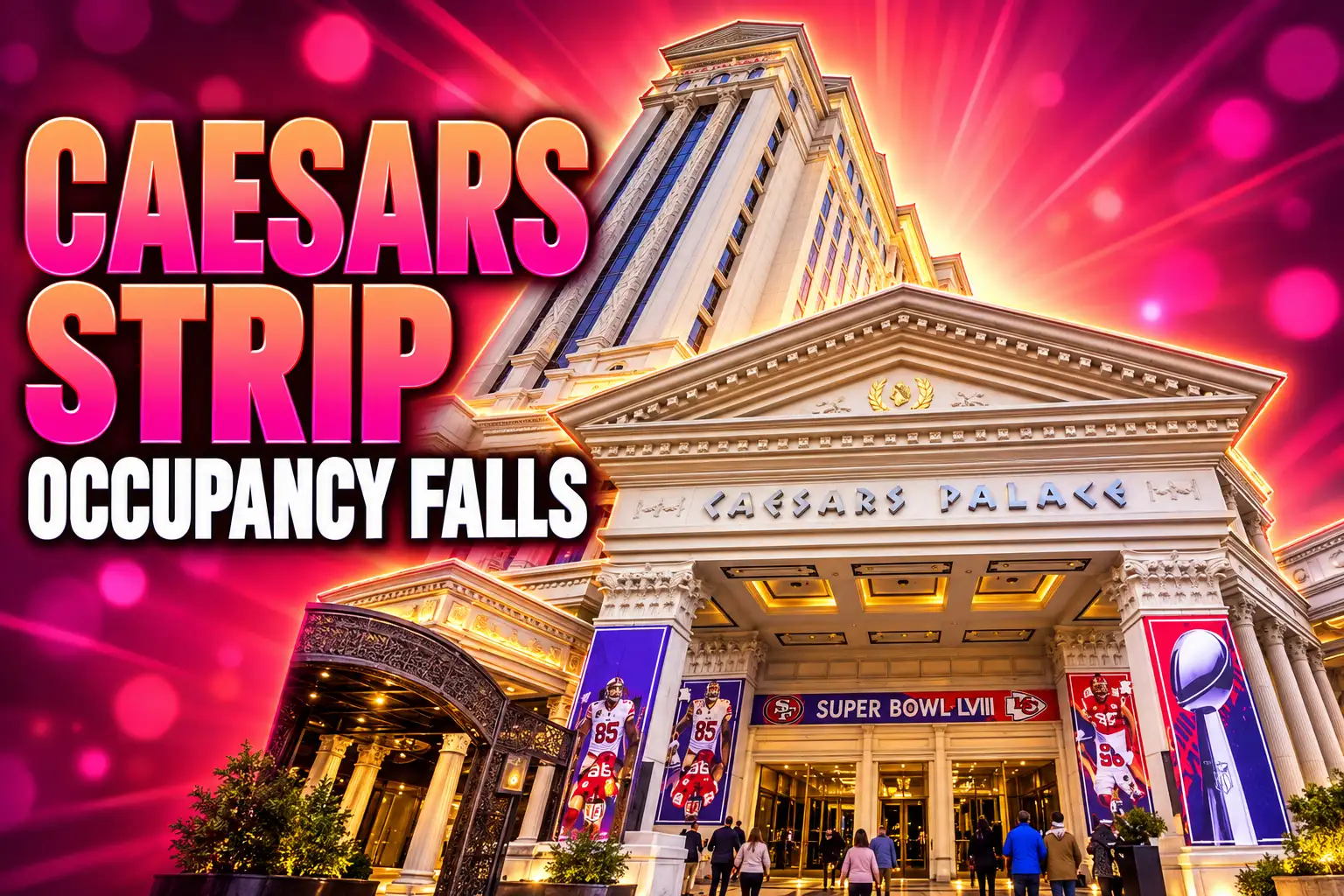
Citywide Volume Is Flat Even as Conventions Surge
Reeg’s 2026 setup was sequential: group business filling around leisure softness in the first quarter, year-over-year gains in the second, and summer hanging on whether the leisure guest came back. The Las Vegas Convention and Visitors Authority’s citywide book is the test of that bet, and it is a split screen.
Las Vegas hosted 38.5 million visitors in 2025, down 7.5%, the lowest tally since 2021, per the authority’s 2025 Las Vegas visitor volume totals. Hotel occupancy averaged 80.3%. Strip occupancy was 83.2%. Citywide ADR was $183.52, down 5.0%, and Strip ADR was $196.54. In 2019 the city drew 42.5 million people.
The July 2026 Las Vegas tourism indicators show the overlay working in one column and stalling in the other. Through July, visitor volume was 22,754,200, up 0.5%. Convention attendance was 3,909,300, up 11.2%. Occupancy inched to 81.3% from 81.1%. ADR rose 3.0% to $188.04. Strip occupancy was 84.4%, with Strip ADR at $201.82, up 3.5%.
LAS VEGAS CITYWIDE, 2025 VS. 2026 THROUGH JULY
| Metric | 2025 full year | 2026 through July |
|---|---|---|
| Visitor volume | 38.5 million, down 7.5% | 22,754,200, up 0.5% |
| Convention attendance | 6.0 million, about flat | 3,909,300, up 11.2% |
| Hotel occupancy | 80.3% | 81.3% |
| Average daily rate | $183.52, down 5.0% | $188.04, up 3.0% |
| Strip occupancy | 83.2% | 84.4% |
| Strip ADR | $196.54 | $201.82, up 3.5% |
July itself drew 3,171,600 visitors, up 2.7%, with occupancy at 77.2% and ADR at $157.45. The authority said leisure demand improved against the slower summer of 2025, while conventions fell 5.6% on show rotation. That is a bounce off a low base, not a return to the old summer. Weekend occupancy in July was 89.1%. Midweek was 71.5%. Downtown occupancy fell to 58.5% from 63.0%.
Canada Still Accounts for a Slice of What Is Missing
Steve Hill, president and CEO of the LVCVA, told Nevada’s Economic Forum in September 2026 that the city was still about 10% below 2019, a gap of 3.5 million to 4 million visitors as of August. Convention growth was covering the loss. Leisure was not.
THE CANADA HOLE IN THE 2025 COUNTS
- Canadian arrivals: 1,196,300 visitors, down 17.4%, a loss of 252,400 from 2024.
- Versus 2019: Canadian travel down about 30%, still the largest international market.
- All international: 4,726,500 visitors, down 4.8%.
- Share of the gap: Hill said the Canada drop equals Australia’s visitation and is 10% to 12% of the missing volume.
He also said domestic airfares were up about 12% in the first four months of 2026, while fares to and from Harry Reid International Airport climbed more than 20%. Expense-account convention travelers absorbed that. Leisure travelers did not. Highway counts from Arizona were down 3.7% over seven months, to 16,802 vehicles a day. Visitor volume through those seven months sat near 22.8 million and had fallen in three of the seven months.
The guest who still comes is older and richer. In 2025, 75% of visitors earned $100,000 or more, and 44% earned $150,000 or more, per the LVCVA visitor profile. Travelers ages 21 to 29 are down more than 10% since 2022. MGM Resorts CEO Bill Hornbuckle has said the company still needs “to solve for Canada and leisure travel.” His team has described luxury as strong and the lower end, including Luxor and Excalibur, as still challenged.
Wynn’s Midweek Rates Went the Other Way
If conventions and big weekends are holding the average rate up, the discounting shows up where the badge traffic is not. A September research note from Truist Securities analyst Barry Jonas put third-quarter Strip room prices 7% below 2025, with the pain concentrated in the middle of the week.
TRUIST STRIP RATE SURVEY, Q3 2026 VS. 2025
| Operator | Overall | Midweek | Weekend |
|---|---|---|---|
| Wynn | up 3% | up 27% | down 9% |
| Caesars | down 11% | down 26% | down 10% |
| MGM | down 9% | down 26% | down 7% |
| Strip overall | down 7% |
Jonas called high-end Wynn “meaningfully outperforming” and tied some of that to Grand Prix-related business. Caesars and MGM were not keeping pace. In September, high-end prices were still off 9% and the middle market off 11%. Wynn CEO Craig Billings has said full-year 2026 group pace remains ahead of 2025 in both room nights and rates. That is the luxury-and-group book Reeg said was holding up on the Center Strip. It is also why a 92% occupancy quarter can coexist with an 11% rate gap.
The public argument around those numbers is still about value, which is why Reeg had to defend the Super Bowl against social media in the first place. Fees, $25 beers, and a sense that the house gets you once are the complaints that keep circulating. They do not empty Saturday night. They thin out the return trip, which is how leisure erodes while the event calendar still looks full. Operators who actually cut friction for Canadians, including at-par room deals, still move people. The destination is not dead. The unbundled midweek trip is.
What a Shoulder Week Does to a 20,000-Room Book
Reeg’s operational point was blunter than the no-crisis sound bite. When there is no big event or big conference, demand gets hard. Caesars might run in the 80s. Other houses run lower. Then the same building has to staff up to full for the next weekend. That is a labor problem dressed up as a tourism headline.
He timed a Caesars Palace construction take around that dip. The Augustus Tower, a little less than 1,000 rooms, was slated for a summer redo so the rooms would be back for Formula 1. That is how a 20,000-room operator now runs Las Vegas: pull inventory in the soft leisure stretch, sell every key when the calendar spikes, and hope group mix covers the weeks in between.
President and COO Anthony Carano told the same call that Las Vegas trends were improving sequentially on occupancy and rate, which cut the EBITDA decline to 6% in the fourth quarter, better than the third. He pointed to a strong group and convention calendar and “stabilizing leisure trends.” Stabilizing is not recovered. Regional properties had a different weather story: December snow cost about $10 million of EBITDA, and the Super Bowl in New Orleans in early 2025 had been worth a little over $10 million that would not repeat in the first quarter of 2026.
Formula 1 Shares the Calendar With a 60% Off Sale
Las Vegas did not host World Cup matches. It hosted the party. From June 11 to July 19 the city tried to turn 104 broadcast games into room nights, with Caesars running Soccer on the Strip across Palace, Harrah’s, The LINQ, Paris, and Planet Hollywood. Visit Las Vegas sold the same idea on a page built for all 104 Cup matches in Las Vegas: the city would not get the FIFA crowds, and it would not get host-city rate spikes either.
That watch-party month sits inside the same July that showed a 2.7% visitor bump and 77.2% occupancy. The next peak on Reeg’s map is already dated. The Formula 1 Heineken Las Vegas Grand Prix returns November 19 to 21, 2026, and Caesars is packing the week with trackside dinners and viewing decks at properties inside the circuit. In between those poles, the company joined the destination’s Vegas 5-Day Sale from September 22 to 26, advertising up to 60% off hotel rooms and $50 show tickets.
THE 2026 DATES DOING THE WORK
- February 17: Reeg tells the earnings call the Strip is in a normal cycle and group mix will offset leisure.
- June 11 to July 19: World Cup watch parties run citywide, with no matches in town.
- July: Caesars Republic Lake Tahoe opens; citywide visitors rise 2.7% off a weak 2025 summer.
- September 22 to 26: Caesars joins a citywide sale at up to 60% off rooms.
- November 19 to 21: Formula 1 returns to the Strip, the next fully occupied weekend on the books.
A 60% off sale in September does not prove Reeg wrong about Saturday night in November. It proves the shoulder is still the business. The same operator can print a record F1, then mark rooms to move them 60 days later. That is cyclicality with a calendar, not a leisure rebound.
Tahoe Opened While the Strip Still Chases Leisure
Carano’s 2026 regional list was explicit: Reno group mix, Windsor moving from managed to owned in March, Harrah’s Oklahoma opening April 9, World Cup property events, and a $200 million Tahoe master plan finishing in summer. The Caesars Republic Lake Tahoe opening in July completed the conversion of Harveys. Connected to Harrah’s Lake Tahoe, the two buildings now offer nearly 1,250 rooms and about 88,000 square feet of gaming. Wolf by Vanderpump and Gordon Ramsay’s Hell’s Kitchen went in with the new casino floor.
That is a second place to catch the guest who is not driving to the Strip on a dead Wednesday. It does not refill California weekends or Canadian weeks on Las Vegas Boulevard. Hill’s September warning was that convention math is covering a leisure leak “not necessarily what we would expect to see indefinitely without steady international recovery.”
We are still gradually losing leisure travelers. Right now our convention attendance is so strong that it is more than overcoming that number.
Steve Hill, President and CEO, Las Vegas Convention and Visitors Authority, Nevada Economic Forum
Reeg’s no-crisis line was a fourth-quarter occupancy number and a group mix, and both were real. The 2026 Strip that followed is the one he described in the next breath: full for the event, soft in the gaps, staffing up and down across 20,000 rooms. Formula 1 weekend will look like the business he was defending. The weeks around it will look like the sale.
Disclaimer: This article is news reporting and analysis of company results and tourism data, and it is for information only. It is not investment advice, a recommendation to buy or sell Caesars Entertainment or any other security, or a forecast of room rates or casino results on which a reader should wager or invest. Anyone considering a financial decision tied to these companies or to Las Vegas travel should consult a licensed financial adviser who can review their own situation. Occupancy, rate, visitor, and earnings figures here reflect the company filings, earnings call, and LVCVA releases cited above and can change in later months.

The Seminole Tribe’s $4 Billion Hard Rock Guitar Takes the Strip

Star Entertainment’s $1 Million Loss Leaves Sydney Exposed

Resorts World Turns a Compliance License Into an Arena Bid

William Latta Claims His First RGPS Tunica Ring

Caesars’ Las Vegas Strip Bet Now Runs Through Conventions

Atlantic City’s 2025 Tourism Win Left a Thinner Resort

The Cosmic Upright Became Light & Wonder’s Quiet Floor Engine

Revo’s Manchester Rebuild Outgrew Its First Approval

New Jersey Asked Miss America Home With No Money

Bally’s Stayed Listed After the $4.6 Billion Takeover
-
 CASINO1 year ago
Atlantic City’s 2025 Tourism Win Left a Thinner Resort
-
 NEWS2 years ago
The Cosmic Upright Became Light & Wonder’s Quiet Floor Engine
-
 CASINO2 years ago
Revo’s Manchester Rebuild Outgrew Its First Approval
-

 CASINO2 years ago
Interior Hands Redding Rancheria the I-5 Casino Frontage
-
 CASINO2 years ago
Bally’s Stayed Listed After the $4.6 Billion Takeover
-
 CASINO2 years ago
New Jersey Asked Miss America Home With No Money
-

 CASINO2 years ago
Churchill Downs’ $100 Million Owensboro Bet Is Paying
-

 NEWS2 years ago
Dutch Courts Leave Pre-2021 Casino Losses With Operators