
CASINO
Regional Casinos Turned a 2025 BofA Call Into Cash
A year after Bank of America’s regional casino call, Penn returned $354.4 million, opened Joliet and Aurora, and watched Vegas lose cheap flights.

Penn Entertainment bought back $354.4 million of stock in 2025 after Bank of America told investors regional casino demand was holding while Las Vegas was not. The buildings then opened, Spirit Airlines stopped flying, and ESPN Bet did not last.
Shaun Kelley, Bank of America’s gaming analyst, had raised his Penn price outlook to $21 from $18 around that September 2025 conference. The cash came back. The ticker never turned the note into a victory lap.
Bank of America’s 2025 Call Put Cash in the Regions
The 15th annual Bank of America Gaming, Lodging and Leisure Conference gathered 34 management teams in New York in early September 2025, including Penn, Caesars Entertainment, MGM Resorts International, DraftKings, and BetMGM. The room’s land-based message was blunt. Players who stay close to home were still spending, and unrated play, the cash that never hits a player’s card, was still improving into the third quarter.
Overall, it seems like the regional consumer is stable or good in most markets. The recent improvement in unrated play appears to be continuing into the third quarter, while 2026 could see less new supply.
Shaun Kelley, Bank of America gaming analyst, 2025 Gaming, Lodging and Leisure Conference
Kelley contrasted that with Las Vegas, where drive-in customers from nearby states had faded, Spirit was already in bankruptcy, and Canadian and overseas trips were light. Any Strip improvement sounded modest. Operators still liked the fourth-quarter event and group calendar. Penn’s example for the regional floor was almost homely: a $10 blackjack hand still cost $10, and the night out had not changed.
Digital shops sounded ready for football. DraftKings talked up parlays, new bet types, and AI to hold down fixed costs. Caesars said every NFL game would carry 175 betting markets, up from 50 the season before, mostly from live same-game plays. BetMGM had already narrowed its sports aim to premium mass customers and said week one of college football was its highest-revenue week even with the NFL and NBA dark.
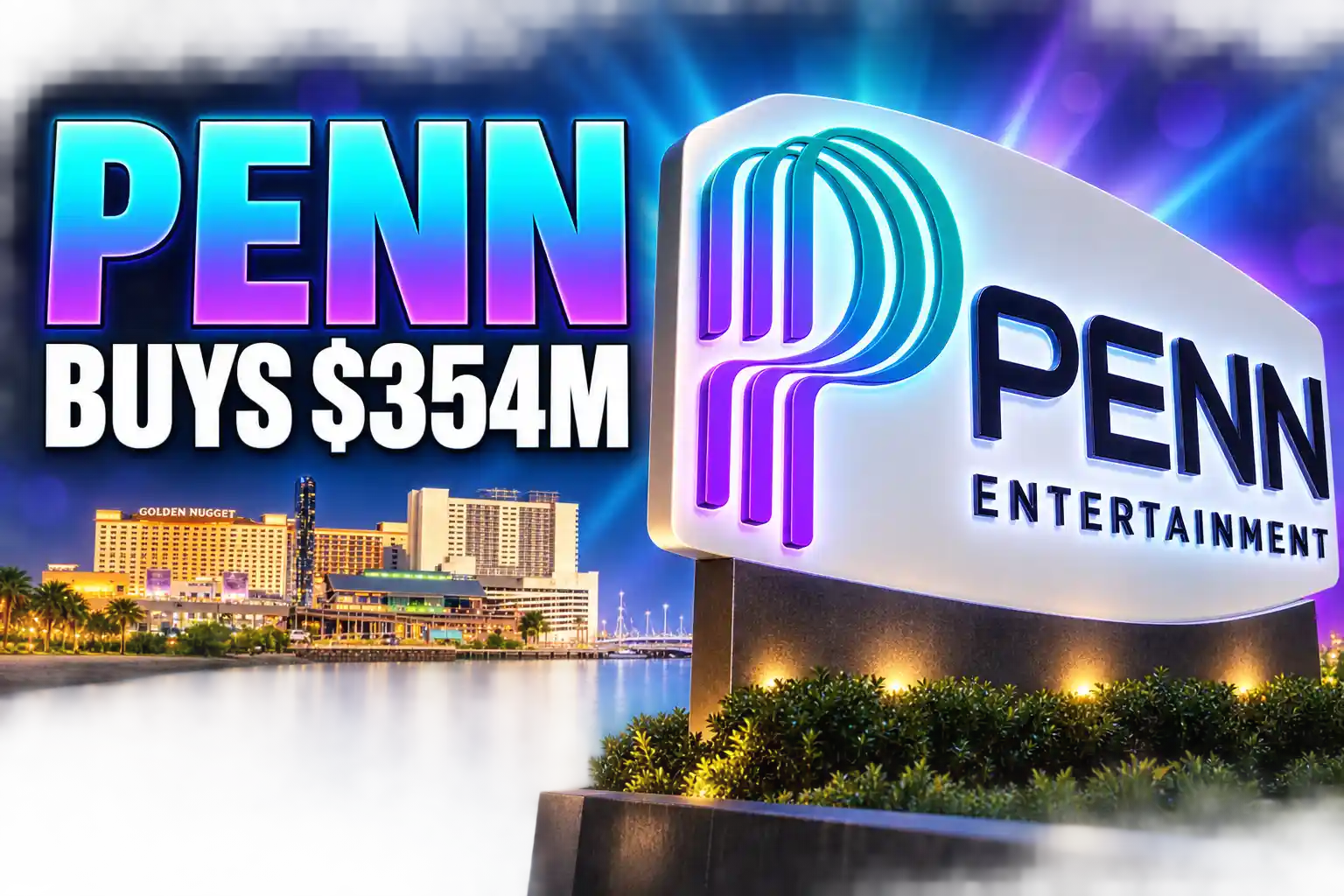
Penn Bought Back $354 Million and Cut 2026 Building
The regional call was also a capital-return call. Kelley said Penn planned to buy back $350 million of shares in 2025 and that project spending would fall in 2026. The company cleared the buyback bar and then replaced it with a larger one.
THE 2025 PLAN VERSUS THE CASH THAT CAME BACK
| Item | September 2025 plan | What closed |
|---|---|---|
| Share buybacks | $350 million in 2025 | $354.4 million, 20,090,831 shares at $17.64 |
| Follow-on repurchase pool | Not set at the conference | $750 million, Jan. 1, 2026 through Dec. 31, 2028 |
| 2026 capital spending | Project capex down year over year | $400 million total ($180 million project, $220 million upkeep) |
| Kelley Penn outlook | $21, from $18 | $22 target on July 20, 2026, Neutral rating |
Penn’s June 30, 2026 quarterly report records the board’s $750 million repurchase authorization and the 2025 buybacks at that $17.64 average. Second-quarter 2026 revenue reached $1,857.4 million, and net income attributable to Penn was $33.1 million. On July 29, 2026, 134,066,591 shares were outstanding.
Jay Snowden, Penn’s chief executive, had already described the stock as cheap on the first-quarter 2026 call, saying it was trading just under $15 the day before and pointing to more than $3 of free cash flow per share that year. Bank of America kept Neutral even after lifting the target to $22 on July 20, 2026. The floor made cash. The multiple did not have to follow.
Hollywood Joliet and Aurora Opened on Schedule
Kelley flagged early Joliet traffic as better than expected, with more new customers than Penn had modeled, plus work still underway in Aurora, Nevada, Columbus, and Council Bluffs. Those jobs were not extra competing casinos so much as boat-to-land replacements and hotel towers. That is one reason 2026 could feel like less new supply even as Penn’s own buildings came online.
THE WATER-TO-LAND CALENDAR
- August 11, 2025: Hollywood Casino Joliet opens as a land-based floor after $130 million of funding from Gaming and Leisure Properties.
- December 1, 2025: The second hotel tower at M Resort in Henderson, Nevada, opens after $150 million of GLPI funding on November 3, 2025.
- June 12, 2026: The Hollywood Casino Columbus hotel tower opens in Ohio.
- June 24, 2026: The $360 million Hollywood Casino and Hotel Aurora opens; Penn takes $216.3 million of a $225.0 million GLPI commitment the same week.
- 2028: The Council Bluffs, Iowa, relocation, still listed as in progress in 2025, is timed for 2028 after spending slipped into later years.
Penn told investors Joliet revenue had been almost entirely additive to Aurora, that the Joliet database had grown 42% since opening, and that more than 50% of that growth came from customers who had gone dark. Aurora closed its riverboat on June 10, 2026, and opened the land building two weeks later. The 2025 conference’s growth list, in other words, mostly converted old boats into new rooms rather than seeding rival markets.
Why Las Vegas Still Feels Soft With Gaming Win Up
Kelley’s 2025 Strip worry was a three-part traffic problem, not a claim that the games would go quiet. A year later the games were still loud. The cheap seats were not.
WHAT HELD, AND WHAT DID NOT
- Drive-in trade: Neighbor-state road trips were already the soft leg in 2025, and that customer never became the 2026 recovery story.
- Spirit Airlines: The carrier halted operations on May 2, 2026. In May it carried about 3,900 Las Vegas passengers, against 511,000 in May 2025.
- Canada and overseas: Steve Hill, chief executive of the Las Vegas Convention and Visitors Authority, told Nevada’s Economic Forum in September 2026 that Canadian trips were down 30% from 2019. Arrivals from Canada fell 17.4% in 2025, to 1,196,300.
Full-year 2025 visitation dropped about 7.5% to roughly 38.5 million, the lowest since 2021. Hill called the split a K-shaped market: the top end still spent, while visitors aged 21 to 29, first-timers, and Canadians thinned out. He also said the city was still losing leisure travelers and that convention traffic was covering the hole.
JULY 2026 LAS VEGAS SNAPSHOT
- Visitors: 3,171,600 in July, up 2.7%, and 22.75 million visitors through July, up 0.5%.
- Conventions: 3,909,300 year to date, up 11.2%, even as July attendance fell 5.6% to 262,700 on show rotation.
- Gaming win: Strip win $776.339 million in July, up 3.6%; Clark County $1.173 billion, up 1.5%.
- Airport: 4,412,684 arriving and departing passengers in July, down 7.6%.
Statewide casinos finished the 2025-26 fiscal year at $16.047 billion of gaming win, up 2.6%, with the Strip at $8.953 billion, up 2%. Profit was another ledger. The Nevada Gaming Control Board’s fiscal 2025 abstract put Strip net income at $154.2 million, down 81.2% from $820.2 million, after $2.2 billion of interest against $21.1 billion of total revenue.
The louder public argument treats those prints as proof the city is either fine or finished. Neither read fits. Group calendars and table drop held up. Budget airline seats, younger guests, and the Canadian share did not, and airfares at Harry Reid were still high after Spirit went dark.
DraftKings Held the 30% Margin as a Distant Target
In September 2025, Kelley said DraftKings still felt confident in 30%+ EBITDA margins and would use AI to offset rising state gaming taxes, while trying to close a slot-share gap against a stronger table-game book. BetMGM’s 30% path, he added, might take longer; at a $500 million EBITDA run he put margins in the mid-teens.
DraftKings has not abandoned the 30% line. It has pushed it out. At its March 2026 investor day the company again said it expects at least a 30% long-term Adjusted EBITDA margin, and it showed how it already cuts promotions in high-tax states: 2.9% of sportsbook handle in states taxing above 30%, against 4.2% in cheaper states.
The second quarter of 2026 showed why the destination margin is still a destination. Sports volume rose 15% to $13.1 billion, up $1.7 billion. Revenue fell 5% to $1,443 million after customer-friendly results and heavier new-customer spend. Adjusted EBITDA was $114.6 million, against $300.6 million a year earlier. Monthly unique payers rose 9% to 3.6 million, while average revenue per unique payer fell 13% to $132.
Our core business remains on track to generate approximately $1 billion of Adjusted EBITDA this year, providing us with financial flexibility to invest behind the significant opportunity that we are seeing in Predictions.
Alan Ellingson, DraftKings chief financial officer, August 6, 2026 earnings release
Jason Robins, DraftKings co-founder and chief executive, said the Super App was live nationwide and that Predictions was growing faster than planned heading into the NFL season. The company kept fiscal 2026 guidance at $6.5 billion to $6.9 billion of revenue and $700 million to $900 million of Adjusted EBITDA, with the core still aimed at about $1 billion of Adjusted EBITDA before that Predictions spend. It was live with mobile sports betting in 27 states, Washington, D.C., and Puerto Rico, about 53% of the U.S. population, and with iGaming in 5 states, about 11%.
The tax line Kelley flagged in 2025 showed up in the operating math. DraftKings’ second-quarter report put cost of revenue at 61.8% of sales, up from 56.5%, primarily from higher state gaming taxes. The 2025 confidence was not empty. It was a margin story that still has to climb through tax rates, hold percentage, and a new predictions product.
ESPN Bet Did Not Survive to the Anniversary
Penn’s digital pitch at the 2025 conference was that it had closed the product gap and that ESPN Bet’s Fan Center could build parlays off a user’s fantasy lineup. Kelley thought Penn and ESPN would still be talking as the three-year mark arrived in August 2026.
They were not. Penn and ESPN cut the deal in November 2025. On December 1, 2025, Penn moved U.S. customers to theScore Bet, the brand it already owned, live then in 21 jurisdictions including Missouri. Snowden told analysts the football season had made the share path clear.
We could see through the first couple of months of football season, while we’re making a lot of improvements in a number of areas, we weren’t on a trajectory to get to that level of market share.
Jay Snowden, Penn Entertainment chief executive, November 2025
He said there were no hard feelings, that both sides had wanted a podium sportsbook, and that it had not worked out. The regional floors, not a national ESPN-branded book, were left carrying the 2025 wager. Interactive was told to get to break-even in 2026, with iCasino and Canada first and U.S. sportsbook used to feed higher-value play rather than to buy share in every state.
August Slowed the Regional Revenue Tape
Kelley was still on the Bank of America gaming and lodging stage on September 9, 2026, this time with hotel companies. The regional cash thesis had not been pulled. In mid-September Goldman Sachs cut its regional casino revenue outlook after August prints slowed in several states, with Penn up 1% in reported markets, Boyd Gaming down 3%, and Caesars down 8%.
That is a one-month tape, not a reversal of Joliet, Aurora, or the $354.4 million. It is a reminder that “stable” never meant immune. The 2025 conference asked operators to bet that locals and unrated play would fund buybacks and finished buildings while Las Vegas waited on flights and groups, and that digital books could defend 30% margins with better apps and AI. The buildings opened. The shares were bought. Spirit is gone. ESPN Bet is gone. DraftKings still prints the 30% figure as a long-term target. Penn still has the $750 million authorization through 2028, which is now the live form of the bet Kelley raised to $21.
Disclaimer: This article is news reporting and analysis of casino operators, conference remarks, and publicly filed figures. It is informational only and is not investment advice, a recommendation to buy or sell any security, or a prediction of future share prices, gaming win, or earnings. Readers who are considering Penn Entertainment, DraftKings, Caesars, MGM, or related stocks should consult a licensed financial adviser who can review their own objectives and risk limits. Share-repurchase totals, price targets, visitation counts, and earnings guidance are taken from company filings, conference comments, and tourism boards as of the dates named in the piece and can change with later reports.

The Seminole Tribe’s $4 Billion Hard Rock Guitar Takes the Strip

Star Entertainment’s $1 Million Loss Leaves Sydney Exposed

Resorts World Turns a Compliance License Into an Arena Bid

William Latta Claims His First RGPS Tunica Ring

Caesars’ Las Vegas Strip Bet Now Runs Through Conventions

Atlantic City’s 2025 Tourism Win Left a Thinner Resort

The Cosmic Upright Became Light & Wonder’s Quiet Floor Engine

Revo’s Manchester Rebuild Outgrew Its First Approval

New Jersey Asked Miss America Home With No Money

Bally’s Stayed Listed After the $4.6 Billion Takeover
-
 CASINO1 year ago
Atlantic City’s 2025 Tourism Win Left a Thinner Resort
-
 NEWS2 years ago
The Cosmic Upright Became Light & Wonder’s Quiet Floor Engine
-
 CASINO2 years ago
Revo’s Manchester Rebuild Outgrew Its First Approval
-
 CASINO2 years ago
New Jersey Asked Miss America Home With No Money
-
 CASINO2 years ago
Interior Hands Redding Rancheria the I-5 Casino Frontage
-
 CASINO2 years ago
Bally’s Stayed Listed After the $4.6 Billion Takeover
-

 CASINO2 years ago
Churchill Downs’ $100 Million Owensboro Bet Is Paying
-
 CASINO12 months ago
Carbone Riviera Takes the Bellagio Room Picasso Left