
CASINO
Casinos Energy and a Green Future: How On-Site Power Fits
Casinos energy barely falls at night, so on-site heat and power is sized to the heat load, and resorts over 2,000 rooms clear the payback screen more often.

The gaming floor stays lit after midnight, and the hot water does not take the night off. Casinos energy use keeps going through the night, with cooling, lights, and guest showers all drawing at once. On-site heat and power fits when you size the plant to heat you can use every hour.
This guide covers the loads that stay on, the room-count screen in the federal assessment, and what working plants at resort casinos have covered. A solar roof and a gas engine answer different hours of that same day.
Casino Loads That Stay On All Night
A casino hotel keeps gaming, guest rooms, food, and laundry running through the same hours, including the hours after the last show. The building wants electricity and heat together, which is the condition on-site generation needs and a quiet office never has.
- Cooling and fresh air: Gaming floors, guest rooms, and public space stay conditioned day and night, and that conditioning is one of the largest draws on the meter.
- Lights: The floor, the signs, the back of house, and the corridors stay on a schedule the sun does not set.
- Hot water: Guest rooms, laundry, kitchens, and spas want a steady supply, including at 2 a.m.
- Kitchens and cold rooms: Cooking and refrigeration follow long service hours rather than a single seating.
- Plug loads: Slots, electronic tables, servers, and point-of-sale gear hold a base demand on the floor itself.
About three fourths of the energy cost in the lodging figures is electricity, and about one fourth is fuel. Power made on site cuts the larger part of the bill only when the captured heat stands in for fuel a boiler would have burned.
2003 ENERGY COST PER AVAILABLE ROOM
- Resort hotels: $2,080, the high end, with amenities and a long operating day stacked on the room.
- Extended-stay hotels: $611.
- Limited-service hotels: $573 on the same per-room measure.
Those are 2003 costs, useful as a comparison and useless as this year’s utility quote. Resorts sit well above limited-service hotels because the extra amenities never really clock out. The assessment put the industry energy bill for that year at $5.2 billion, about 5 percent of lodging revenue.
Electric Load at a 2,000-Room Casino Hotel
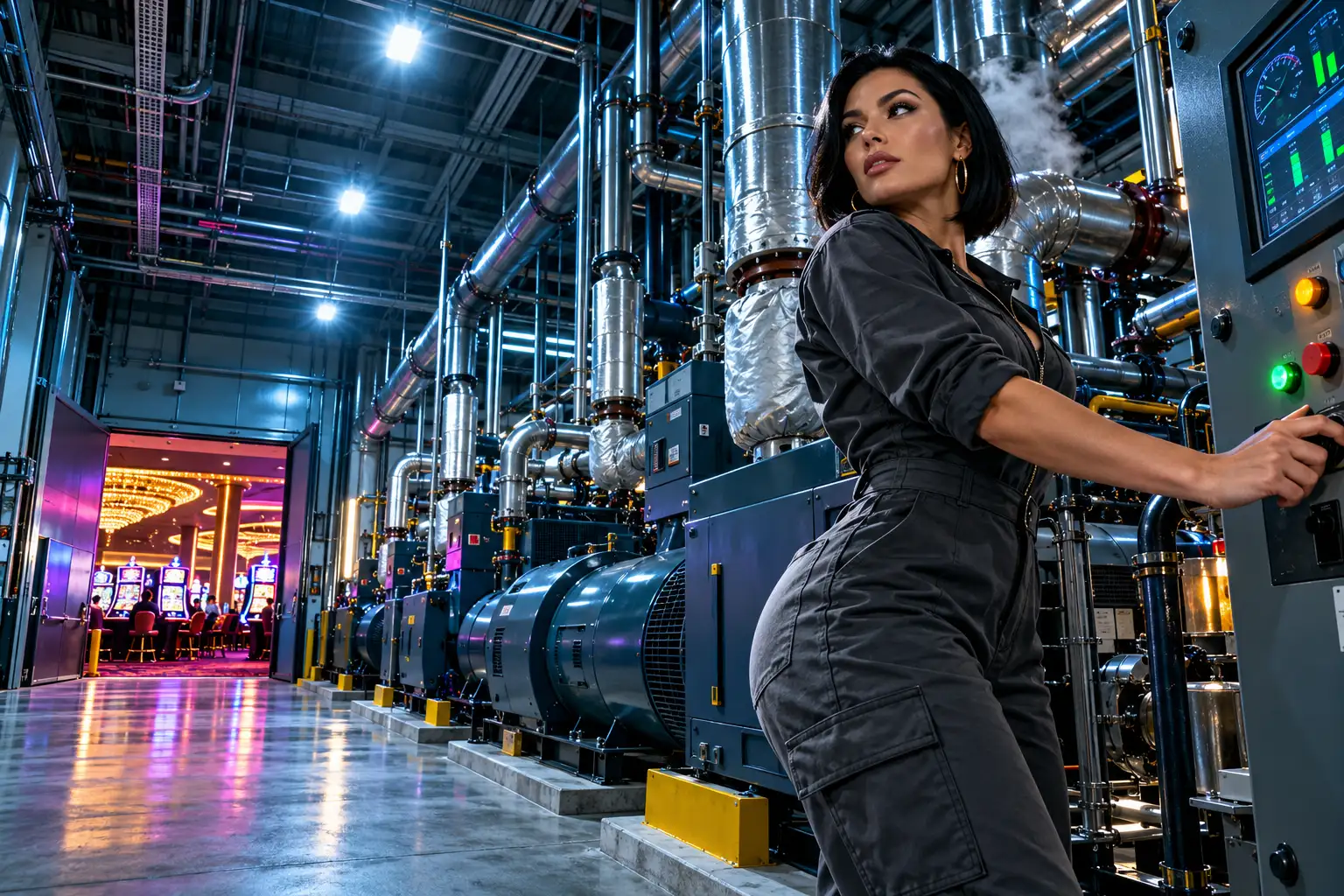
The night floor is a measured quantity, not a slogan. The assessment built four cases for a 2,000-room casino hotel, with Atlantic City as the cold-climate stand-in and Las Vegas as the hot one, and with cooling either from waste heat or from electric chillers. One Atlantic City case is actual operating data. The other three are estimates drawn from Turning Stone and Borgata loads.
| Case | Minimum | Average | Peak | Annual electricity | Steady heat |
|---|---|---|---|---|---|
| Atlantic City, actual, waste-heat cooling | 7.0 MW | 9.8 MW | 16.1 MW | 86.1 million kWh | 30 MMBtu/hour |
| Atlantic City, estimate, electric cooling | 7.4 MW | 11.3 MW | 21.3 MW | 99.4 million kWh | 12 MMBtu/hour |
| Las Vegas, estimate, waste-heat cooling | 7.0 MW | 9.8 MW | 16.1 MW | 86.1 million kWh | 29 MMBtu/hour |
| Las Vegas, estimate, electric cooling | 7.4 MW | 12.0 MW | 21.3 MW | 104.9 million kWh | 12 MMBtu/hour |
Read the minimum column before the peak. The floor sits at 7.0 or 7.4 MW in every case, while the peak moves with the way the building makes cold water. A generator sized under that floor has somewhere to send power in the slowest hour the model contains. The steady-heat column is the partner to that floor: it jumps when cooling is done with waste heat, which is why large resorts study absorption chillers.
How Does Combined Heat and Power Serve a Casino?
Combined heat and power, often called CHP, burns one fuel at the property, makes electricity, and catches heat a power-only unit would throw away. You can send that heat to guest showers, laundry, kitchen water, the pool, space heating, and, on a large enough plant, a chiller that makes cold water from hot water or steam.
The EPA fact sheet for resort casinos calls the usual design thermal base-loading. You size the unit to heat you can use, and that unit then covers 50 to 70 percent of the electricity rather than the whole meter. Space cooling is the main thermal job at a large hotel or casino. Space heat, domestic hot water, laundry, restaurants, and the pool can share the same pipes.
On a smaller full-service hotel the same rule lands on a smaller machine. The assessment ran one full-service prototype through hot, mild, and cold weather, and the night electric floor barely moved between those cities. A unit matched to hot water came out smaller than that floor, so it can stay fully loaded without a complicated on-off plan.
- The prototype: 230 rooms and 195,000 square feet, modeled for Las Vegas, Anaheim, and Minneapolis.
- Annual electricity: About 3 to 3.5 million kWh.
- Night electric floor: About 240 to 260 kW, similar in the hot, mild, and cold runs.
- Heat-matched size: About 134 to 178 kW, under that floor so the unit can run steadily.
- Warm-climate gas: 64 percent of annual gas use sits on water heating, the slice CHP is aimed at.
- Cold-climate gas: More than twice the hot-climate or mild-climate gas use, because space heat grows.
- Hot-climate power: Electric use runs 16 percent above the mild and cold cases.
- Absorption cooling: Not treated as cost-effective until the generator is about 300 kW, enough for about a 100-ton chiller, on hotels with more than 200 rooms.
Guest-room hot water is the thermal load to trust on a smaller property. Night heat use drops, and the assessment calls those swings wide. Kitchens, laundry, pools, and seasonal space heat can fill the gaps. They are add-ons, and an absorption chiller below the cutoff above fights the assessment on its own terms.
Which Hotel Size Clears the CHP Payback Screen?
The December 2005 hotel and casino assessment did not treat every lodging property as a candidate. It drew the line at 100 rooms. Nearly 48,000 hotels were in the country, and fewer than 10,000 had the usage shape for CHP technology at that time.
The EPA hotels and casinos briefing puts a payback cut on that group: more than 1,000 of the suitable sites were likely to return their cost within five years. The table below is the size screen behind that judgment. Technical and economic megawatts are the remaining market after hotels that already had a plant.
| Rooms | Hotels | Already with CHP | Remaining sites | Suggested size | Technical MW | Economic MW | Share economic |
|---|---|---|---|---|---|---|---|
| 100 to 199 | 6,323 | 33 | 6,290 | 90 kW | 566 | 130 | 22.9% |
| 200 to 499 | 2,614 | 30 | 2,584 | 380 kW | 982 | 371 | 37.8% |
| 500 to 999 | 379 | 9 | 370 | 1,000 kW | 370 | 170 | 45.9% |
| 1,000 to 1,999 | 116 | 5 | 111 | 5,000 kW | 555 | 495 | 89.2% |
| 2,000 and up | 32 | 2 | 30 | 10,000 kW | 300 | 290 | 96.7% |
| Total | 9,464 | 79 | 9,385 | 2,773 | 1,456 | 52.5% |
Gas and electric prices in that assessment sit under the economic column. Read the share column as a map of where payback was easiest, not as a bid for a lender this month.
In the 100 to 199 room band, 22.9 percent of the technical potential also cleared the economic screen. Above 2,000 rooms that share is 96.7 percent.
Hotels of 1,000 rooms or more account for 54 percent of the economic potential in the screen. Of the hotels above 2,000 rooms, 75 percent were on the Las Vegas Strip.
In that assessment, market penetration was just under 1 percent of available sites. The Department of Energy hotel fact sheet later describes the installed stock from the hotel side and says over 80 percent of hotel CHP systems are under 1 MW. Mega-resorts are where that fact sheet finds the most favorable economics, in line with the share column here, and those plants can cover lights, elevators, and plug loads as well as heat.
What Do Working Casino Plants Cover?
Published resort plants are the check on the screen. The rows below are large projects with an electric share, a heat job, and a money result. A 90 kW hotel engine in the first screen band is a different machine and should not be judged by these rows.
| Plant | Started | Capacity | Electricity covered | Heat and money |
|---|---|---|---|---|
| Rio, Las Vegas | May 1, 2004 | 4.9 MW, six gas engines | 40 percent | 60 percent of hot water and 65 percent of heating; $1.5 million a year; payback just over four and a half years |
| Seneca Niagara Falls | December 2005 | about 6 MW, three gas engines | about 73 percent at peak | Sized to the thermal load; summer heating, cooling, and hot water expected in full; payback expected within four years |
| Foxwoods, Connecticut | 2010 | 15 MW, two gas turbines | nearly 60 percent | Heating and cooling in full; nearly $36 million recouped over three years |
The Rio Plant in Las Vegas
The Rio All-Suite Hotel and Casino was the first Las Vegas casino plant of this type, built against a $9 million annual energy bill. Six natural-gas engines carry the job in the table.
- Fuel: 34 percent less than separate boilers plus purchased electricity.
- Efficiency: About 75 percent overall.
The project received a CHP certificate of recognition for lower fuel use and lower pollution. The assessment dates that certificate to 2003, before the May 1, 2004 start, so treat it as a project award rather than a year of operating results.
Seneca After the Northeast Blackout
Seneca Niagara Falls Casino added its plant after the property had already lived through a regional blackout. The design choice was to keep selected loads up if the grid failed, which is a harder job than shaving a bill on a normal day.
Sizing followed the heat, not the electric peak. At this property that heat is three jobs at once.
- Space heating: Guest and public areas in cold weather.
- Space cooling: The summer load an absorption path is meant to take.
- Domestic hot water: The guest and back-of-house supply that does not clock out.
In summer the expectation was that those thermal needs would be met in full. That is a different promise from a standby generator on a few emergency panels while the floor stays dark.
The Foxwoods Turbines in Connecticut
Foxwoods tied a large plant to a clean-energy goal at a resort that does not close. Two gas turbines make up the capacity in the table, and the project write-up puts overall efficiency at 82.5 percent.
Heat from those turbines was described as covering both heating and cooling, the large-resort version of the absorption idea in the screen. The money result is recovered cost over three years, not the simple payback reported for the Rio, so the rows are not one formula.
When Paris Las Vegas Lost Power
A different morning shows what happens when the backup cannot carry the floor. A hotel and casino CHP project sheet records a 2016 morning at Paris Las Vegas, and it does not claim that property had combined heat and power.
WHAT THE OUTAGE TOOK
- The clock: Power stayed out about 13 hours.
- The guests: With the backup failed, the property evacuated about 3,000 guests.
- The games: Staff had to rebuild winnings, including a $1,000 slot cash-out that went dark mid-payout.
- The loss figure: The hotel did not publish a revenue number, citing the guest cases still to sort.
The outage became an evacuation and a reconstruction of bets, not only a dark sign on the roof. A plant helps in that hour only if it is built to keep running when the utility does not.
How to Judge a Property for Casino CHP
You can do a first pass before anyone models a plant. The February 2007 resort fact sheet gave operators six questions and treated three or more yes answers as a reason to study a project, not as an order for engines.
FEBRUARY 2007 FIT QUESTIONS
- The price: Do you pay more than 7 cents per kilowatt-hour for electricity?
- The bill: Are high or rising utility costs a live worry?
- The backup: Are you adding or replacing backup generators?
- The chilled water: Does the property have a central chilled-water system?
- The calendar: Are you planning new construction, an expansion, or a major HVAC retrofit?
- The emissions goal: Do you want to cut the environmental impact of operations?
The price question is frozen in 2007 rates, so rerun it against your current tariff, including demand charges, gas, and maintenance. A yes on backup generators or a boiler replacement is often the cleaner signal, because that is money you may spend anyway.
Size the unit to heat you can use in a slow hour, not to the afternoon electric peak. Keep absorption cooling on generators that clear the cutoff already listed, about 300 kW and hotels with more than 200 rooms. On a smaller hotel, count guest-room hot water first. If that load falls off overnight and laundry or pool heat cannot fill it, the plant will cycle, and the screen assumed a unit that stays on.
The practical window is the one the fact sheet names. Look hard when you are already replacing boilers or chillers, or when you are drawing a new building, so the CHP capital can stand in for equipment the project would buy in any case.
Casinos Energy Use and Rooftop Solar
The plants in this record burn natural gas. The documented gain is lower fuel use than making electricity in one place and heat in another, which is what the Rio fuel comparison measures. That gain is an efficiency result on a gas flame. Rooftop panels do a separate job.
Panels on a roof or a garage cut purchased electricity while the sun is strong, and a desert resort has a real resource in those hours. They leave the night floor and the 3 a.m. hot water to another source, unless you add storage the CHP screen never assumed. A property can own both. Put the engine or turbine on the heat you can use every hour, and let the panels take a slice of the daytime purchases.
Frequently Asked Questions
Can a Moored Casino Barge Use Combined Heat and Power?
A barge that stays tied to the dock can take electricity and hot water the way a building does, and that is the test that matters. The hotel and casino assessment treated permanently moored riverboat casinos as able to receive service like permanent buildings, and it treated a boat that still cruises as a weaker candidate.
Will Any CHP Plant Keep a Casino Open in a Blackout?
No. The plant keeps the floor open only if it is designed and permitted to separate from the grid and carry chosen loads. The resort fact sheet notes that an outage can cost a casino more than $1 million a day in lost revenue, which is why that design choice matters. A unit that must shut off when the utility fails will not hold the games, and Seneca Niagara was built for the version that can.
Who Maintains a Casino CHP Plant?
Either a service contract or the crew you already employ can keep the plant in order. The resort fact sheet says owners can buy coverage for maintenance, service, and operations, or train existing staff to do the work.
How Often Was the Rio CHP Plant Available?
The Rio plant was available and operating more than 95 percent of the time in the federal project record. That uptime figure belongs to that installation, and it is not a guarantee you can copy onto a different engine in a different city.
Are Tribal Casinos Part of the Same CHP Screen?
Yes. Unrestricted land-based casinos, commercial and tribal, are the group the assessment calls the best target, because the fit is the round-the-clock electric and thermal load. The license does not replace that load test.
Before you compare acreage for panels, ask the chief engineer for the lowest electric demand after midnight on a normal week, and for the hot water the guest rooms and laundry need in that same hour. If both stay up, you are in the part of the market the screen treated as a real project. If the heat falls away overnight, stay with a heat-matched unit at a smaller hotel, or skip the plant.
Disclaimer: This guide explains how casino and hotel energy loads relate to on-site combined heat and power, using published federal assessments and project records. It is informational only and is not an energy audit, an engineering design, or financial advice. Have a qualified energy engineer and your utility review any project before you buy equipment or change a plant. Costs, rates, and rules in the sources belong to the years cited and can move.

Ho-Chunk Gaming Beloit Opens a $705 Million Border Bet

The Seminole Tribe’s $4 Billion Hard Rock Guitar Takes the Strip

Star Entertainment’s $1 Million Loss Leaves Sydney Exposed

Resorts World Turns a Compliance License Into an Arena Bid

William Latta Claims His First RGPS Tunica Ring

Atlantic City’s 2025 Tourism Win Left a Thinner Resort

Revo’s Manchester Rebuild Outgrew Its First Approval

The Cosmic Upright Became Light & Wonder’s Quiet Floor Engine
The Seminole Tribe’s $4 Billion Hard Rock Guitar Takes the Strip

Harrah’s Ak-Chin Hands the Floor to Its Marketing Chief
-
 CASINO1 year ago
Atlantic City’s 2025 Tourism Win Left a Thinner Resort
-
 CASINO2 years ago
Revo’s Manchester Rebuild Outgrew Its First Approval
-
 NEWS2 years ago
The Cosmic Upright Became Light & Wonder’s Quiet Floor Engine
-
 CASINO2 years ago
Interior Hands Redding Rancheria the I-5 Casino Frontage
-

 CASINO1 year ago
Carbone Riviera Takes the Bellagio Room Picasso Left
-
 CASINO2 years ago
Harrah’s Ak-Chin Hands the Floor to Its Marketing Chief
-
 CASINO5 months ago
The Seminole Tribe’s $4 Billion Hard Rock Guitar Takes the Strip
-

 CASINO2 years ago
Bally’s Stayed Listed After the $4.6 Billion Takeover