
CASINO
Boyd’s Norfolk Rescue Left a Tent Holding the License
A 132-slot tent saved Norfolk’s 2020 casino vote. Boyd’s $750 million riverfront resort is six stories high and still aimed at late 2027.

Norfolk’s long-delayed waterfront casino is open as a 132-slot tent, while Boyd Gaming and the Pamunkey Indian Tribe raise a $750 million resort for late 2027.
City Council’s 7-1 vote on September 10, 2024, brought Boyd in as majority owner of the operating company. The Interim Gaming Hall opened November 7, 2025, and that placeholder is still the only gaming floor on the Harbor Park site.
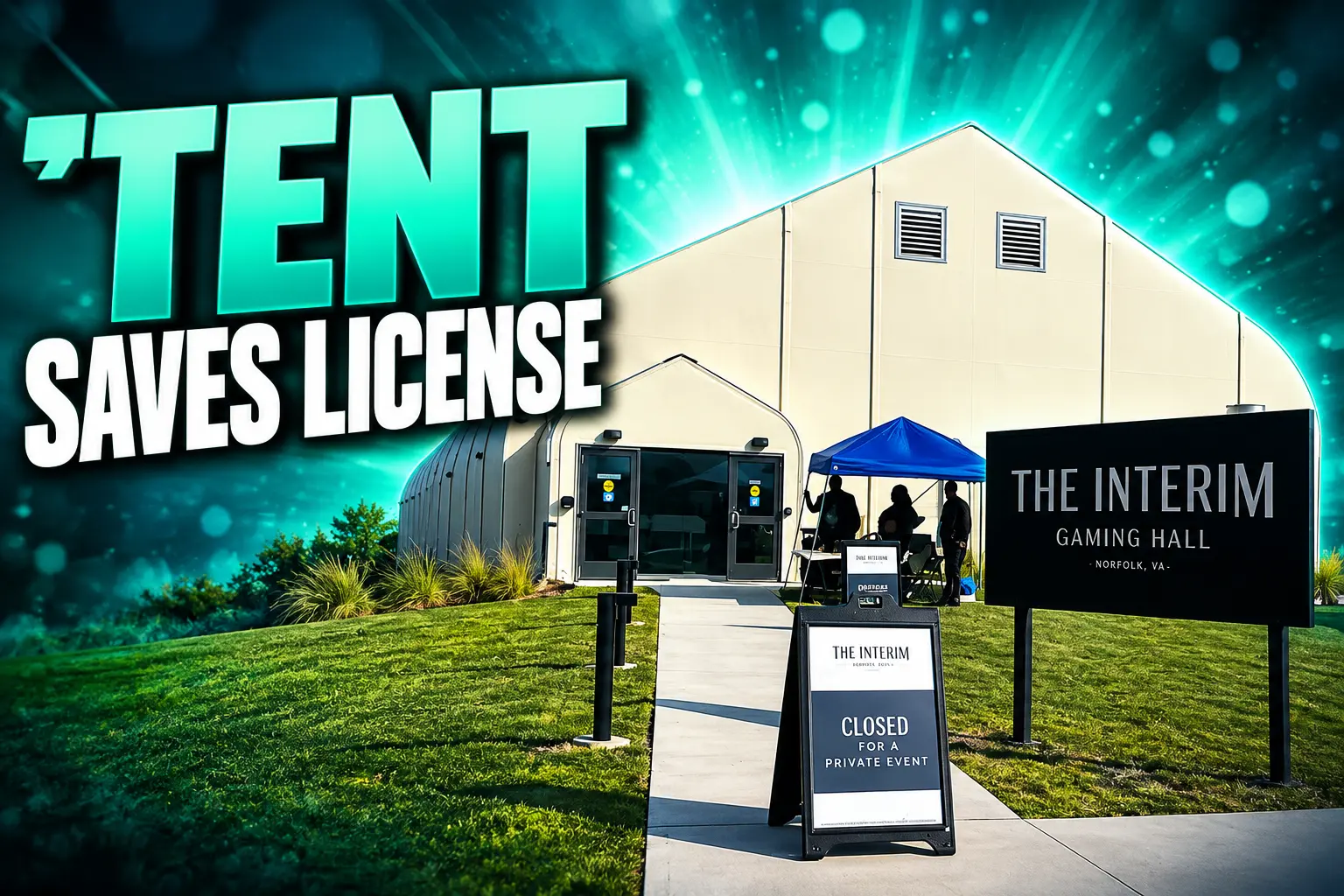
A Tent With 132 Slots Kept the License Alive
The hall sits in a 7,200-square-foot sprung structure on Park Avenue, beside Harbor Park and the Elizabeth River. Guests play 132 slot machines. There are no table games. Hours run from 10 a.m. to 2 a.m., food comes from a truck, and Boyd Rewards cards work at the machines.
Ron Bailey, vice president and general manager, cut the ribbon with a short line: “It’s finally here, let the games begin.” Keith Smith, Boyd’s president and chief executive, later told investors the tent is a placeholder. On the company’s April 23, 2026, earnings call he said the site left no room to make it bigger, and that the hall is expected to break even “until we open in November 2027.”
THE TENT IN BRIEF
- The floor: 132 slot machines and no tables, per Virginia Lottery monthly counts.
- The hours: Daily play from 10 a.m. to 2 a.m.
- The shell: A 7,200-square-foot sprung structure built to be taken down.
- The point: Hold a state license on the river while the hotel and casino rise next door.
Uri Clinton, a Boyd executive vice president, described that shell to the council in 2024 as “a sprung structure, something to put up, operate and pull down.” It was never the product voters were shown. It was the device that kept the license from expiring.
Virginia Law Gave the City Five Years
Norfolk voters approved a casino on November 3, 2020, by about two-thirds. The court order certifying that result went out on November 18, 2020. Under the Code of Virginia, a new local vote is required if the Lottery Board has not granted a license inside a five-year window after a referendum.
That clock ran to November 18, 2025. Design fights, a seawall that erased a planned marina, and a stalled partnership with Tennessee investor Jon Yarbrough burned most of those years. Portsmouth, Bristol, and Danville already had casinos while Norfolk’s river lot sat empty.
THE CLOCK THAT FORCED THE TENT
- November 3, 2020: Norfolk voters approve a casino referendum by about two-thirds.
- November 18, 2020: A court order certifies the result and starts the five-year license window.
- September 10, 2024: City Council votes 7-1 to bring Boyd in and sell 9.35 acres for $10.5 million.
- October 30, 2024: Mayor Kenny Alexander, Smith, and Pamunkey Chief Robert Gray break ground.
- October 29, 2025: The Virginia Lottery Board grants Golden Eagle Corporation II a license by unanimous vote.
- November 7, 2025: The Interim Gaming Hall opens, eight days before the November 15 date operators said they had to meet.
- Late 2027: Boyd targets opening of the permanent riverfront resort.
Ken Rodman, Mid-Atlantic real estate leader at VHB, said the firm’s local ties let it fast-track permits for the tent, including flood certification, and finish the hall in under one year. Without that building, the 2020 vote would have gone back to the ballot.
Boyd Took Majority Control of Golden Eagle
The preferred operator is no longer the tribe. Golden Eagle Consulting, once wholly owned by the Pamunkey for the project, is now majority-owned by Boyd. City documents put the tribe’s stake at least at 20 percent, which leaves as much as 80 percent with the Las Vegas company. The licensed entity is Golden Eagle Corporation II.
That split is the quiet change inside a project still sold under a tribal name. Ahead of the 2020 vote, the tribe told residents that members of the community, not an out-of-state casino company, would run the house and put money back into Norfolk. Boyd now holds the wheel, and the tribe holds a minority share plus the political brand.
Gray pushed back on the word “rescue,” which Council members Tommy Smigiel and Andria McClellan both used the night of the vote. “It’s our project,” Gray said. “But with that ‘our project,’ that’s what we choose to do with it.” Mayor Alexander was blunter about the stall. The tribe, he said, had been “struggling to get the project out of the ground,” and Boyd had “the financial strength to build a world-class casino resort hotel.”
Boyd lists 28 gaming properties in 10 states and already manages a tribal casino in Northern California. Smith has called greater Norfolk one of the largest underserved gaming markets in the mid-Atlantic, with 1.8 million people in Hampton Roads and about 15 million visitors a year to nearby Virginia Beach. The company is putting $300 million of 2026 growth capital into the Virginia job, against a $750 million project budget.
What Norfolk Voters Approved in 2020
The 2020 pitch was a $700 million riverfront resort with a 500-room hotel, as many as 4,500 slot machines, and as many as 225 table games. City original operator-selection revenue estimates put stabilized gaming take between $350 million and $400 million a year and pictured almost 2,500 jobs.
By the 2024 vote the hotel was 200 rooms. The game count was 1,500 slots and 50 tables. The marina was gone, eaten by a city seawall along the Elizabeth River. The development agreement still only binds Boyd to the $300 million minimum in state law. Clinton told the council Boyd would not back away from a $500 million spend. Boyd’s public budget now is $750 million, a higher dollar figure on a smaller hotel.
THE 2020 PITCH VERSUS THE BOYD PLAN
| Item | 2020 public pitch | Plan under Boyd |
|---|---|---|
| Hotel rooms | 500 | 200 |
| Slot machines | Up to 4,500 | 1,500 |
| Table games | Up to 225 | 50 |
| Stated project cost | $700 million | $750 million |
| Preferred operator | Pamunkey Indian Tribe | Golden Eagle, Boyd majority |
| Annual city tax cited | More than $30 million | $15 million, per Smigiel |
Smigiel, who voted yes, later said a Boyd briefing to the city had cut annual tax projections to $15 million from more than $30 million in 2020. Ward Shaw, a Boyd executive vice president, has put the first five years at 850 jobs, $1.2 billion in economic output, and $187.6 million in gaming tax, with a 10-year impact of $2.9 billion. Those are company figures, not audited results.
The Steel Frame Has Reached Six Stories
Smith told investors in February 2026 that foundation work was largely done and the 12-story building was going vertical. By September 2026 the frame stood at six stories, about half its planned height, after crews set 1,000 tons of steel and poured 35,000 cubic yards of concrete. Bailey said then, “We are on schedule, we are on budget.”
The permanent house is still unnamed. HeadWaters was the tribal brand. Boyd said a new name would come in 2026; as of September that year it had not landed in public. The resort is meant to replace the tent in late 2027.
WHAT THE PERMANENT HOUSE IS SUPPOSED TO HOLD
- The casino: A 65,000-square-foot floor with 1,500 slots, 50 tables, and a sportsbook.
- The hotel: 200 rooms in a tower Boyd has described as 12 stories.
- The deck: 45,000 square feet of outdoor amenity space with a pool.
- The rest: Eight restaurants and bars, 13,000 square feet of meeting space, a 4,000-square-foot spa and gym, and a 1,000-space garage with Amtrak spots.
In August 2026, Bailey signed a training agreement with Tidewater Community College, a local pipeline for jobs that are still more than a year from the full opening. The tent keeps a small staff busy until then. The larger hiring wave is tied to the hotel, the restaurants, and the tables that do not exist yet.
Norfolk Collects Little From the Tent Each Month
Virginia Lottery figures show how small the placeholder is. In its first 23 days in November 2025, the hall posted $1,412,587 in adjusted gaming revenue, wagers minus winnings, and Norfolk received $84,755. December came in at $1.1 million. The city took about $154,000 from those first two months.
Later months settled near $1 million. April 2026 was $958,255. May was about $1.1 million, with $64,839 going to Norfolk. August was $1.1 million again. Host cities receive 6 percent of adjusted gaming revenue until a property crosses $200 million in a year, then 7 percent, then 8 percent above $400 million. The tent will not see those upper rungs.
AUGUST 2026 ADJUSTED GAMING REVENUE
| Property | August 2026 AGR |
|---|---|
| Interim Gaming Hall, Norfolk | $1.1 million |
| Live! Virginia, Petersburg (temporary) | $14.3 million |
| Five licensed Virginia properties, total | $97.6 million |
Petersburg’s temporary casino, a much larger floor with tables, took in more than twelve times Norfolk’s August figure. Smith has already answered the obvious question. The Norfolk lot is too tight, he said, to grow the tent without crowding out the permanent building. Live! is a different site and a different bet. Norfolk’s early money is the price of saving the license on a postage-stamp parcel.
Because the hall is tied to a tribe, 1 percent of its tax payment goes to the Virginia Indigenous People’s Trust Fund for other federally recognized tribes in the state. May’s slice was $10,806. Statewide, land-based casinos and sportsbooks produced about $311 million in gaming tax in 2025, according to Virginia commercial casino tax totals compiled by the American Gaming Association. Norfolk’s tent is a rounding error in that pile, and it will stay one until the 1,500 slots and 50 tables switch on.
McClellan Cast the Only No Vote
Councilwoman Andria McClellan was the lone no on September 10, 2024. She had opposed the casino from the first drawing, and she said the Boyd papers still left her public-safety questions unanswered, including police staffing and neighborhood strain. She also flagged the shrink from the 2020 resort.
I think we’ve been dealt a bad hand, to use gambling parlance.
Andria McClellan, Norfolk City Council, September 10, 2024, council vote
McClellan said feedback in her district suggested a fresh referendum would fail. The city attorney told council a smoke-free casino was off the table because the operator would not agree, given the money involved. Those fights did not stop the land sale, the license, or the tent.
Chief Kevin Brown, speaking for the tribe when the Lottery Board issued the license, called the paper “a milestone of opportunity” and a chance for jobs and a long partnership with Norfolk. Alexander has kept to the same civic pitch he used in 2024, tax money and a live waterfront next to the ballpark. The steel at six stories is the first physical proof that pitch can still be built. The 132 machines under fabric are the proof of what the city actually cashes while it waits through 2027.

The Seminole Tribe’s $4 Billion Hard Rock Guitar Takes the Strip

Star Entertainment’s $1 Million Loss Leaves Sydney Exposed

Resorts World Turns a Compliance License Into an Arena Bid

William Latta Claims His First RGPS Tunica Ring

Caesars’ Las Vegas Strip Bet Now Runs Through Conventions

Atlantic City’s 2025 Tourism Win Left a Thinner Resort

The Cosmic Upright Became Light & Wonder’s Quiet Floor Engine

Revo’s Manchester Rebuild Outgrew Its First Approval

New Jersey Asked Miss America Home With No Money

Bally’s Stayed Listed After the $4.6 Billion Takeover
-
 CASINO1 year ago
Atlantic City’s 2025 Tourism Win Left a Thinner Resort
-
 NEWS2 years ago
The Cosmic Upright Became Light & Wonder’s Quiet Floor Engine
-
 CASINO2 years ago
Revo’s Manchester Rebuild Outgrew Its First Approval
-
 CASINO2 years ago
Interior Hands Redding Rancheria the I-5 Casino Frontage
-
 CASINO2 years ago
Bally’s Stayed Listed After the $4.6 Billion Takeover
-
 CASINO2 years ago
New Jersey Asked Miss America Home With No Money
-

 CASINO2 years ago
Churchill Downs’ $100 Million Owensboro Bet Is Paying
-

 NEWS2 years ago
Dutch Courts Leave Pre-2021 Casino Losses With Operators